
Media to Learning Design
Overview
Before transitioning into learning design, I worked in broadcast and media involved in a wide range of productions reaching up to 30 million viewers. This section outlines how I translate my television and media background into high-impact learning experiences that make abstract or complex concepts easy to understand.
Skills Transition Chart
| Media & Broadcast Skill | Instructional Design Equivalent | Strategic Business Value |
|---|---|---|
| Scriptwriting & Pacing | Storyboarding & Content Chunking | Simplifies technical concepts into digestible learning steps. |
| Audience Engagement Metrics | Learner-Centric Needs Analysis | Turns training into what the audience needs to solve real-world problems. |
| Video Editing & Production | Multimedia Development (e-Learning) | Builds visually polished assets that increase learner retention. |
| Directing & Talent Interview | SME (Subject Matter Expert) Management | Extracts and captures critical knowledge from experts efficiently . |
| Shooting & Post-Production | Project Management & Agile Design | Delivers complex training projects on schedule, from concept to launch. |
Case Studies
Cancer Research Documentary
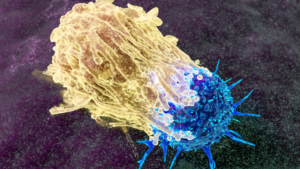
Project: A prime-time medical science documentary exploring cutting-edge oncology and cellular biology, reaching 7 million broad viewers. (NHK, Frontiers of Intellectual Exploration – Cancer, 2026)
https://www.web.nhk/tv/pl/series-tep-RQQ16KG694/ep/GZ9LKK152V
You can watch some snippets from the 73 minutes science show in the private link below.
Complexity: Translating highly abstract, microscopic concepts, more specifically the evolutionary dynamics of tumours and how the epigenetics of dormant cancer cells can be switched on or off, into clear, non-technical language.
Learning Design Solution:
- Behavioural Call-to-Action: Used cellular science not just to inform, but to deeply convince viewers of the tangible health benefits behind early screenings and preventative lifestyle habits.
- Metaphorical Scaffolding: Framed tumour progression through the lens of Darwinian evolution, making the complex concept of cellular mutation and survival instantly relatable to a general audience.
- Connecting Micro to Macro: Bridged the gap between unseen genetic and epigenetic processes and our everyday experiences, demonstrating visually how our body goes through cellular environmental changes.
Dementia Research Documentary
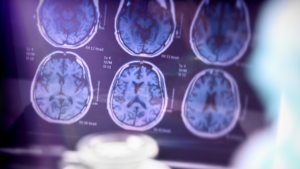
Project: A prime-time science documentary exploring cutting-edge neurology with a high-profile presenter and a Nobel Prize laureate, Prof. Shinya Yamanaka, reaching 7 million viewers. (NHK, Frontiers of Intellectual Exploration – Dementia, 2025)
https://www.web.nhk/tv/pl/series-tep-RQQ16KG694/ep/V35G9996GW
Complexity: Translating advanced genetic science, e.g., how the APOE4 gene variant increases dementia risk in late life yet correlates with higher cognitive function in youth.
Learning Design Solution:
- Interactive Engagement: Converted passive scientific data into an audience-facing quiz format to drive viewer participation.
- Actionable Takeaways: Balanced complex genetic theory with clear, practical steps on how socializing and exercise mitigate cognitive decline.
- Information Layering: Structured a human-centred narrative to hook the audience before layering in deep clinical research.
Quantum Physics Programme

Project: A educational science TV programme focused on demystifying quantum entanglement and advanced quantum communication systems. (NHK, Cosmic Front, 2019)
Complexity: Explaining abstract, highly mathematical physics concepts such as Einstein’s “spooky action at a distance” and how the Cosmic Bell Test uses 8-billion-year-old quasar light to prove quantum nonlocality.
Learning Design Solution:
- Visualising the Invisible: Translated a complex quantum imaging laboratory experiment, where entangled laser beams are split into different wavelengths, into an intuitive graphic sequence.
- The Quantum Cat Hook: Used a cat-shaped stencil as a tangible visual anchor, which showed viewers how red photons interacting with the cat stencil instantaneously altered their entangled yellow twin photons traveling to a camera, rendering a cat silhouette purely from light that never touched the object.
- Cognitive Scaffolding: Leveraged the audience’s familiarity with Schrödinger’s cat to bridge the gap between theoretical quantum superposition and real-world quantum cryptography network technologies.
Alan Turing, Computer, and AI
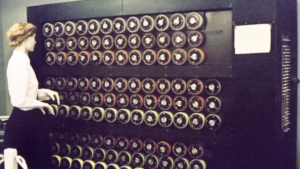
Project: A historical science documentary following the biography of Alan Turing, tracing his achievements through the real-world locations associated with his life. (NHK, Frankenstein’s Lure, 2017)
Complexity: Demystifying abstract, foundational computer science theories, especially what a universal computer actually is and how artificial intelligence is defined, for a general television audience.
Learning Design Solution:
- Spatial Anchoring: Used geographic locations (like Bletchley Park, NPL, and the University of Manchester) as visual milestones to transition the audience from war-time codebreaking to modern computing.
- The Imitation Game Framework: Explained complex AI concepts by turning the theoretical Turing Test into a relatable, visualised dialogue experiment, demonstrating how a machine mimics human thought.
- Biographical Scaffolding: Tied abstract mathematical logic directly to Turing’s personal stakes, humanising the historical birth of technology to maintain an emotional connection with the viewer.
Biomechanics Documentary
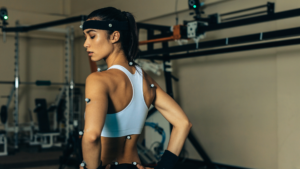
Project: A scientific sports documentary following famous German Paralympic long jumper Markus Rehm as he underwent advanced biomechanics testing, reaching 4 million viewers. (NHK, Miracle Body, 2016)
Complexity: Explaining complex data and experimental procedures regarding whether a carbon-fibre prosthetic blade offers an unfair advantage, the ultimate deciding factor for his Olympic eligibility.
The Learning Design Solution:
- Visualising the Invisible: Utilised motion-capture data and on-screen data overlays to make invisible physics forces, force application, and take-off efficiency instantly visible to a general audience.
- Objective Narrative Framing: Structured the presentation of the scientific results, showing a less efficient run-up but a more efficient jump, to let viewers understand how international athletic boards weigh the balance of probabilities.
- High-Stakes Hooking: Anchored dense laboratory physics to a compelling, high-stakes human question: Will science allow this athlete to compete on the world’s biggest stage?
Below is the showreel from my broadcast projects. It does not contain any AI generated footage.