
PhD Research
Overview
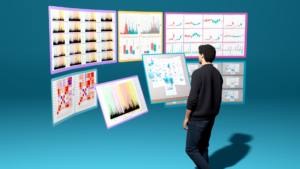
EdTech x Cognitive Science x Mixed Reality
My doctoral research focused on how Mixed Reality (MR) can enhance human cognition in context of multimodal and multidimensional data analysis. By investigating the impact of MR technology on humans, I established actionable design frameworks for the next generation of spatial computing.
Core Competencies
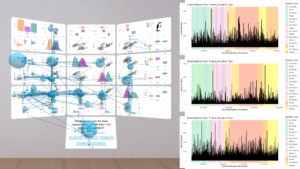
- XR Prototyping: End-to-end development of interactive 3D environments and data visualisations in Unity and Blender for HoloLens 2.
- Mixed-Methods Research: Designed and executed rigorous Eye-Tracking studies, quantitative behavioural analysis in R and Python, and semi-structured interviews followed by thematic analysis.
- Design Framework: Translated complex experimental data into a practical MR Design Framework that optimises human attentional limit and working memory load.
Key Research Insights
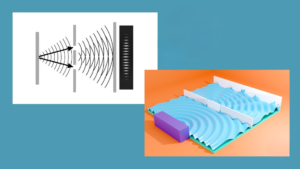
- Initial Hypothesis: Stereoscopic 3D spatial models would automatically bridge the gap for users with lower spatial ability.
- Discovery: 3D models alone did not magically solve spatial ability limitations. Instead, the true value of MR lies in externalising information.
- Cognitive Benefit: Utilising infinite MR space offloads the user’s working memory demand, freeing up cognitive capacity and facilitating data organisation for complex problem-solving.
Research Studies & Methodology
Study 1: Mental Rotation with 2D vs. 3D Representations
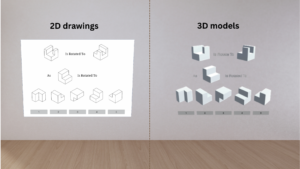
- Experiment: A comparative study evaluating how users interact with 2D drawings versus 3D spatial models within a head-mounted display when performing mental rotation tasks.
- Role: Developed the custom HoloLens 2 application in Unity, integrated live eye-tracking logging mechanisms, and analysed gaze patterns and eye movement metrics.
Study 2: Screen Space vs. Infinite Virtual Space
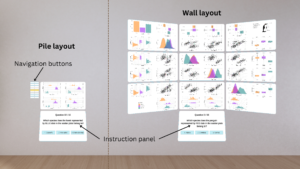
- Experiment: A quantitative study measuring performance and cognitive load when tasks were restricted to a traditional computer monitor versus an extended, immersive MR workspace.
- Role: Programmed the custom HoloLens 2 application in Unity, tracked user completion times and error rates, and modelled cognitive load and mapped visual attention, using eye-tracking metrics and visualisation techniques.
Study 3: Immersive Analytics for Data Specialists
- Experiment: A qualitative investigation into how professional data researchers, such as bioinformaticians and geospatial scientists, interact with complex datasets when brought into a 3D environment.
- Role: Conducted in-depth semi-structured interviews, performed thematic analysis, and identified specific user needs and bottlenecks in spatial data visualisation.
The Output: MR Design Framework
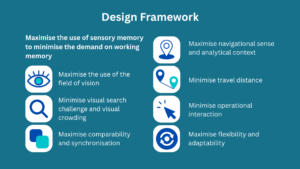
The culmination of this research is a validated MR Design Framework for immersive analytics. It provides developers and instructional designers with concrete guidelines on:
- When to use 3D models vs. 2D spatial panels to make the system more effective.
- How to arrange virtual assets to match natural human eye-movement and behavioural patterns.
- Strategies for externalising data to lower working memory demands during high-complexity tasks.