
Corporate Microlearning
Overview
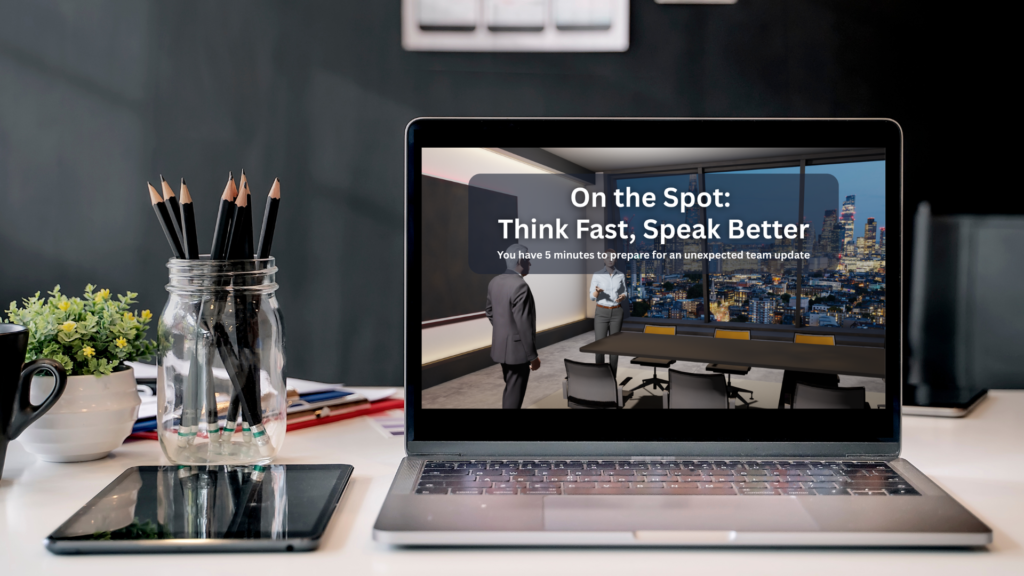
This microlearning module (a concept project) simulates a workplace scenario in 3D graphics where the learner is asked to deliver a quick team update with minimal preparation time. The experience makes learners to experience the pressure of delivering a speech in scenario-based learning to build confidence in everyday speaking situations.
- Audience: Corporate employees looking to build confidence and effectiveness in impromptu speaking
- Responsibilities: End-to-end instructional design andevelopment
- Tools: Articulate Storyline, Blender, Unity, Canva, Final Cut Pro, ChatGPT, Gemini, Heygen, Luvvoice, Figma, Visual Studio Code, Google Docs
Problem
Professionals frequently face high anxiety when put on the spot to deliver spontaneous updates without preparation. However, traditional training lacks the realistic, low-stakes environments required to practice these high-pressure moments safely.
Solution
This module bridges that gap by offering an interactive, scenario-based 3D simulation. It allows learners to practice real-time structuring and speaking opportunity, which transforms workplace anxiety into confident, structured communication.
Process
- Instructional Design Framework: Grounded in the ADDIE model, the module’s lifecycle was structured through analysis of learner anxiety and organisational needs, followed by systematic design and development, and user testing.
- Psychological Theories: The 3D simulation leverages Inhibitory Learning Theory by exposing users to high-pressure scenarios in a safe environment to rewrite the brain’s anxiety response into confident communication.
- Action Mapping: Identified core problems and mapped specific, measurable behaviours required for confident impromptu speaking.
- Text-Based Storyboarding: Scripted realistic workplace scenarios, turning decision paths into quizzes and immediate feedback using an asynchronous text format.
- Visual Mockups: Designed clean, modern UI layouts and visual anchors to mirror a high-pressure corporate meeting environment.
- Development: Built and tested the interactive prototype within an industry-standard authoring tool to ensure seamless navigation.
Results
- Validated Design Framework: Proved the effectiveness of scenario-based learning for soft-skills training in a corporate environment.
- Scalable Blueprint: Created a repeatable, high-fidelity template for rapid prototyping of future workplace communication modules.
- Positive Feedback: Received positive peer feedback during user testing for the realistic narrative and relatable action simulation where they actually felt pressure.
- Future Enhancement: This framework can be further elevated by integrating CustomGPTs to provide learners with scalable, tailored feedback for high-impact training where budget is not a constraint.